Blog | Presence | Contact Us | Login
Boeing - IIT National Aeromodelling Competition 2018 Final Round
  • Online Courses
    • 3D Printer
    • Automobile Prototyping
    • CNC Machine using Arduino
    • Gear Train Design
    • Robotics Online Courses
    • School Level Courses
    • Animatronic Hand
    • Robotic Arm
    • Biped Walking Robot
    • Hexapod
    • 2 Mechatronics Projects
    • Mechatronics (Career Building Course)
  • Classroom Trainings
    • Aeromodelling Workshops
    • Mechanical Workshops
    • Automobile Workshops
    • Electronics Workshops
    • Robotics Workshops
    • Mechatronics Workshops
    • School level Workshops
    • Winter Training Program
  • Training Centres

      Upcoming Workshops happening in

      Online
      Can't find venue near by?
      Request one here
  • Summer Training
  • More
    • Boeing Aeromodelling Competition
    • Request Workshop
    • Request Sponsorship
    • Request Seminar
    • Contact Us
    • Blog
    • Gallery
    • Testimonials
    • Careers
    • Resources
    • Offers
    • Presence
    • About Us
    • News
    • Limca Book of Records
    • Investors
    • Team
  • Verify Certificate
  • Request Workshop
  • Offers

Boeing - IIT National Aeromodelling Competition

Sponsored by Boeing. Conducted in association with IITB, IITD, IITK, IITKGP, IITM and AerotriX.

Boeing - IIT National Aeromodelling Competition 2017-18 - Final Round

You are currently viewing the past event. To check the details of Boeing - IIT National Aeromodelling Competition 2019-20

Problem Statement

A team has to design, fabricate and demonstrate a fixed wing aircraft system that can perform maneuvers mentioned below with given constraints

Design Constraints:

  1. T/W < 0.75 (if excess thrust is found, it will be neutralized by adding weight below the plane at center of gravity). The weight of the aircraft without any payloads will be considered for the Thrust/Weight measurement.
  2. Propeller diameter should not be greater than 10 inches.
  3. Battery weight should not be more than 120 gm.
  4. Only electrical motors are allowed. The use of IC engines or any other means of providing thrust is prohibited.
  5. Use of gyroscopes (gyros) and programming assistance in receivers is prohibited.
  6. One of the team members should fly the aircraft and another should call the stunts as they are performed (just before).

Abstract Submission

  1. All the participants need to submit an abstract on their aircraft, which should be no longer than 15 pages (A4 size 1.5 line spacing) with standard formatting. The Abstract must document the basic design of the aircraft (dimensions, wing areas, velocity, etc.) and should also explain how their design is suitable for given problem
  2. Along with the abstract, participants also have to send a zip file containing at-least 5 and no more than 10 photographs of the aircraft while it is being built
  3. The Abstract has to be submitted as per the format mentioned. Click here for abstract format
  4. The Abstract has to be submitted 20 days in advance of the Final Competition date

Format of the Competition

The competition requires the participants to design and fabricate a RC plane (Readymade Planes are strictly not allowed) and perform a set of maneuvers. Propellers, Motors, ESC, Servos, Receiver and Transmitter are allowed as off-the-shelf items. The event will be conducted at the ground of IIT Delhi and participants will need to bring their aircrafts and all necessary equipment to this venue. The arena will be placed in an open ground.

Maneuver Round

Arena:
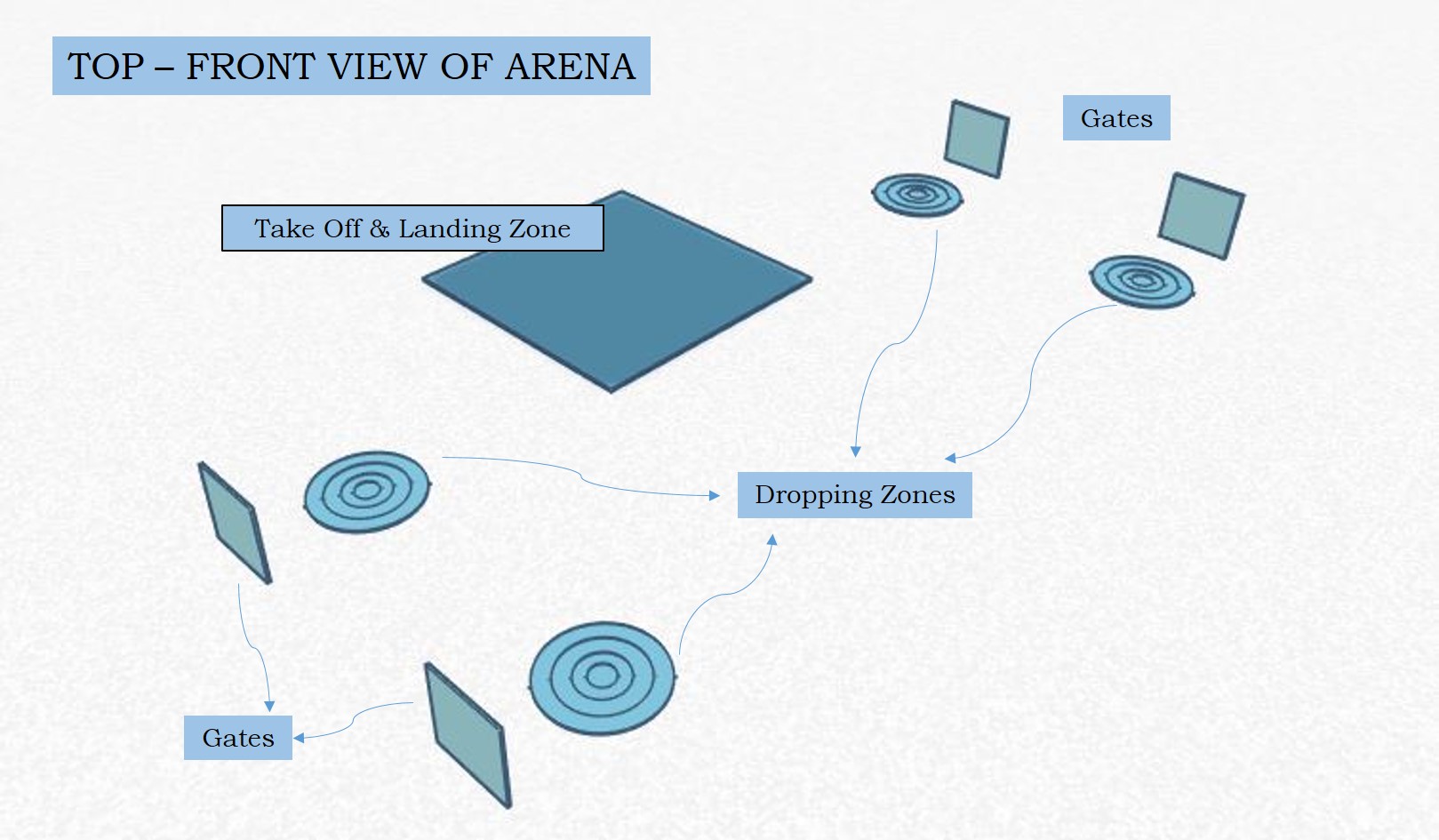
  • The Arena consists of 4 gates - a set of 2 gates placed symmetrically on either side of a Take Off / Landing Zone. (Refer to the diagram for details)
  • There are 4 concentric circles adjacent to each gate that form a target for Object Dropping
  • All the gates have a horizontal bar at 5 meters height from the ground
  • Each gate would have enough space for planes to pass through, yet only the skills of the pilot can guarantee a swift maneuver
  • Each of the gates will be at 25 meters from the edges of the Take Off / Landing Zone and are symmetrically positioned from the Take Off/Landing Zone

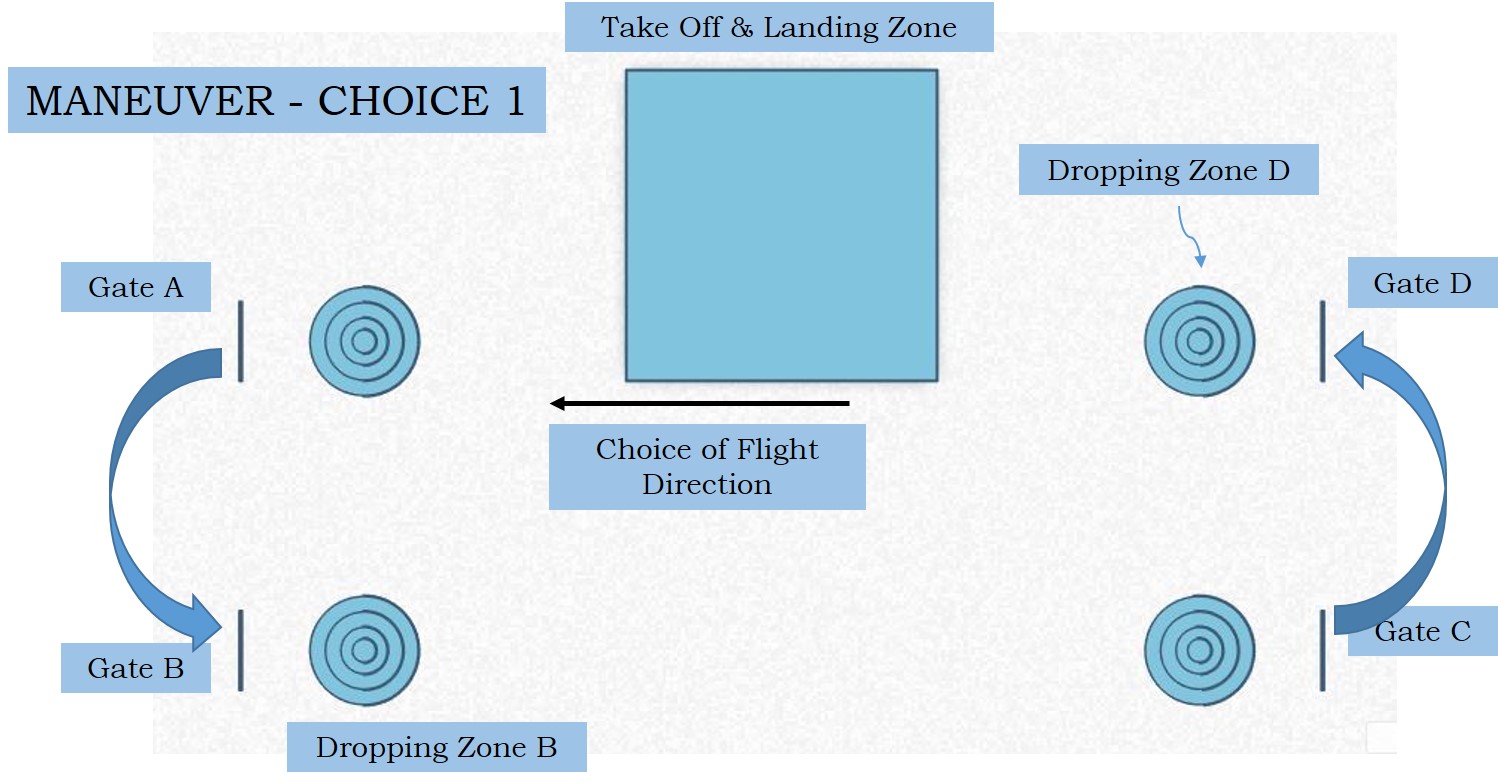
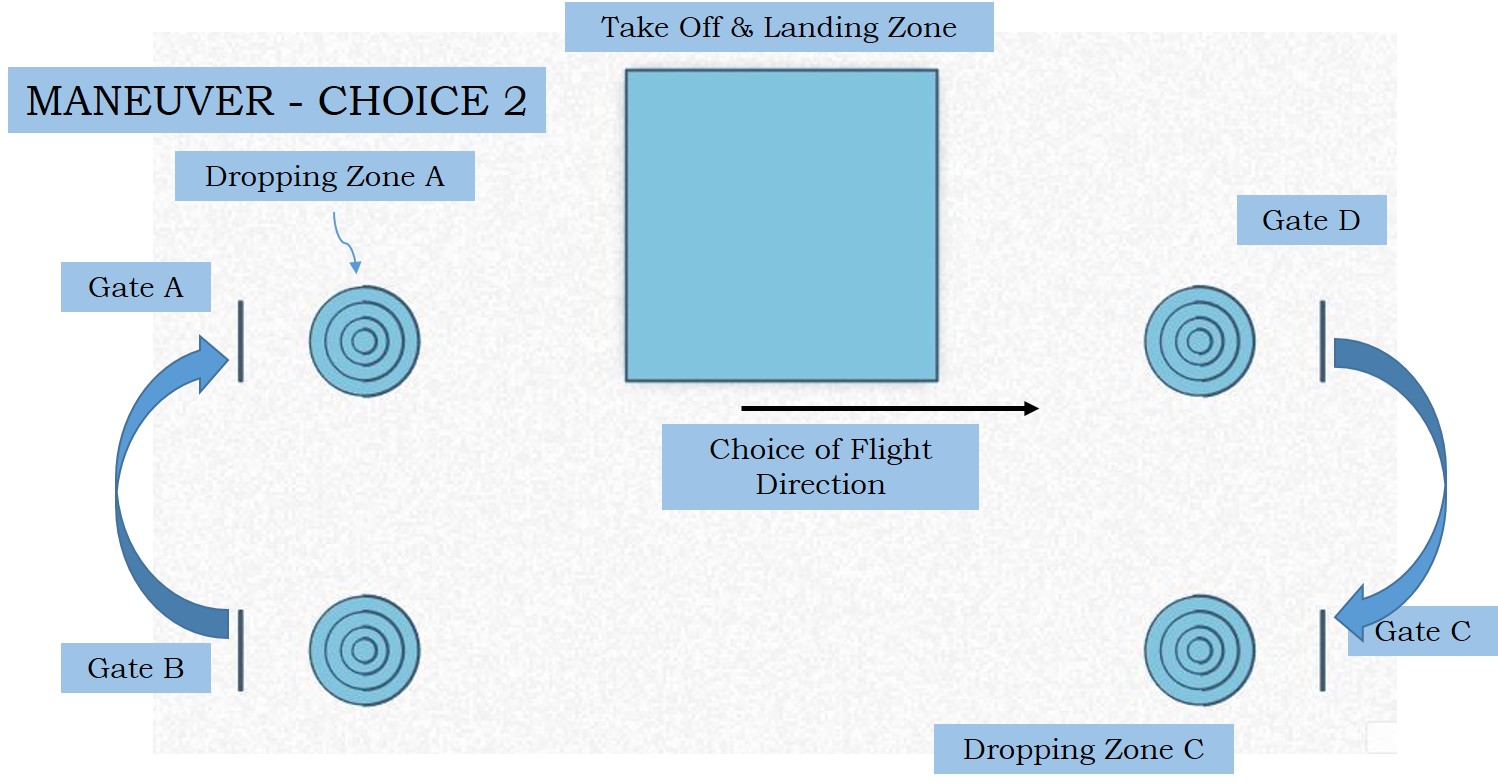
The participants can choose to take-off to the left or the right of the Take Off Zone. Based on the take-off direction, the series of gates and the dropping zones will be decided. If the maneuver is from A to D, the Dropping Zones will be B & D. If the maneuver is from D to A, the Dropping Zones will be to C & B. (For a better understanding of the arena, refer to the illustrations on the right).

Steps of the Maneuver
Step Maneuver Points
Step 1 Take Off from Take Off Zone Mandatory
Step 2 Passing through Gate A (or D) 100 points
Step 3 Passing through Gate B (or C) 300 points
Step 4 Dropping Object in Zone B (or C) Points according to table below
Step 5 Passing through Gate C (or B) 300 points
Step 6 Passing through Gate D (or A) 500 points
Step 7 Dropping Object in Zone D (or A) Points according to table below
Step 8 Landing in Landing Zone 100 points

Points for Object Dropping will be awarded according to the following table.

Target Hit Location Dropping Zone 1 Dropping Zone 2
a Innermost circle
Diameter - 1.5m
1000 points 1700 points
b Second circle
Diameter - 3m
700 points 1400 points
c Third circle
Diameter - 5m
500 points 1200 points
d Fourth circle
Diameter - 7m
400 points 1100 points

A maximum time of 4 minutes will be given between the first take off and the final landing. Any further instructions would be given before the competition, on the spot.

Scoring Guidelines for Maneuver Round
  1. The team should keep attempting the maneuver until they complete all steps in that order in one attempt without landing
  2. After completing all steps mentioned in the maneuver, teams are eligible to score additional points as mentioned below
  3. The following guidelines should be followed for additional points:
    1. The teams can attempt the same maneuver multiple times within the time limit
    2. For each attempt, partial step-wise points will be awarded i.e. if the team completes steps 1&2, they get points for 1&2 and so on
    3. The steps have to be performed only in the given order. No points will be awarded for steps done in incorrect order. For example, if a plane does steps 1&3 without doing 2, points for step 1 will only be awarded.
    4. The aircraft should have at least 2 objects in/on it at any point before attempting the Step 2 for additional points
    5. The participants' planes can carry more than 2 objects and repeat the maneuvers multiple times without having to refill. The landing of the aircraft is not mandatory for the repeat maneuvers.
    6. A number of similarly shaped and sized objects will be kept in the take off zone for subsequent object dropping maneuvers

If there is a tie, winner will be decided by a separate round framed by the Judges on the spot. Judges' decisions would be considered final in all cases.

General Guidelines for Maneuver Round

  1. The plane has to carry at least 2 objects (of dead mass) of dimension 2cm X 2cm X 2cm and weighing less than 50 grams
  2. One of the 2 objects has to be dropped in Dropping Zone 1 and the other has to be dropped in Dropping Zone 2
  3. As all the gates are placed symmetrically, the pilot can choose either of the direction for the entry to perform the maneuvers, but he/she has to call out his direction of choice soon after take-off
  4. The Pilot will try to drop the dead weights in innermost circle of 4 concentric circles drawn on the ground.
  5. The pilot is allowed to change his choice of entry direction while in flight, but he/she has to call out the same and any stages performed prior to the change of direction will be considered void
  6. The location of the dropping area w.r.t the gates and the gates w.r.t the take off/landing zone is shown in the arena illustration
  7. The participants are allowed to bring a Radio which has a maximum of 6 channels

Rules:

  1. Each team would be given 2 chances for each of the rounds and the best score is considered as per the scoring procedure mentioned above for each round.
  2. The timer will start the moment the participating team enters the take-off zone with the plane or within 30 secs of previous team completing their attempt, whichever is earlier. The participants need to be prepared in time and launch without delay after entering the take-off zone
  3. Awards will be announced based on the performance of the teams in the Maneuver Round.

Revisions

Any revisions to the Scope of the Competition would be intimated to all the participants via registered email and on the websites of the respective festivals at-least 10 days before the event takes place.

General Guidelines for the Competition

  1. The use of 2.4 GHz radio is required for all aircraft competing in the competition. If the participants want to use any other frequency, they will have to inform the organizers in advance.
  2. A limited number of 2.4 GHz radios will be available with the organizers for use by the teams. Teams who do not have access to radios can inform the organizers in advance to request use of these radios.
  3. Receivers installed in the aircraft have to be in 'receiver mode only'.
  4. All the systems (Servos, motor, etc.) will be checked by organizers for functionality before the competition. If found not working, teams will be dismissed from the competition.
  5. Pilot can position himself at any point in the arena to fly the aircraft during the rounds.
  6. Metal propellers are not allowed.
  7. The models can have powered take-off with a landing gear or can be launched manually by a person standing at ground level.
  8. Plane should be built from scratch and not purchased models.
  9. A team member can’t be a part of more than one team.
  10. No additional members can be added to the teams selected for the finals
  11. Participants have to bring their college/student Identity Card, in addition to a bona fide certificate from the college/institution
  12. Travelling allowance (max. 3-tier AC railway fare) will be provided to all members of the teams participating in the final round. The participants have to submit printed copies of their tickets with the fare to avail the same
  13. Teams can reach one day in advance to IIT Delhi for practicing
  14. All teams have to report at IIT Delhi campus by 4 PM on Day 0
  15. Any of the above mentioned rules, if found violated, teams would not be allowed to participate in the competition.

Schedule :

Plan for Day 0
Time Activity Venue
6 AM - 6 PM Practice Session (optional) Hockey Ground
6:30 PM Assembling of Teams Hockey Ground
6:45 PM Thrust to weight checking and handing over of models Hockey Ground

Plan for Day 1
Time Activity Venue
7:45 AM Assembling of Teams for competition Hockey Ground
8:15 AM Start of Attempt 1 of Maneuver Round Hockey Ground
10:15 AM Start of Attempt 2 of Maneuver Round / Media Briefing* Hockey Ground
12:15 PM Completion of on ground events --
12:30 PM Lunch/ Media Briefing* Hockey Ground Pavilion
6:00 PM Prize Distribution Ceremony TBD
7:00 PM Dinner TBD
*Media Briefing would go on in parallel along with the event/ lunch

Award Policy

1. For the Final Winners
  • Winner - Rs. 1,00,000
  • 1st Runner-Up - Rs. 50,000
  • 2nd Runner-Up - Rs. 30,000
2. Winners will get certificate indicating their positions at the final round of the competition signed by Boeing and the Organizing Committee of the competition.

Contact Information

AerotriX is the overall coordinator for the events across India. Participants can also contact AerotriX for any issues they have.

Email: info@aerotrix.com
Phone: 1800-200-3855 (Toll-Free)

Download

Download the Problem Statement from Here

Arena Information

Boeing IIT National Aeromodelling Competition 2018 Final Arena Top View


Boeing IIT National Aeromodelling Competition 2018 Final Arena Top Front View


Boeing IIT National Aeromodelling Competition 2018 Final Maneuver 1


Boeing IIT National Aeromodelling Competition 2018 Final Maneuver 2


Boeing IIT National Aeromodelling Competition 2017 Final Arena Object Dropping Zone


☎ Have a Query?

18002003855


*To close this window press ESC or click outside window.

About Us | Limca Book of Records | Resources | Blog | FAQs | Privacy Policy | Refund Policy | Request Workshop | Request Sponsorship | Verify Certificate | Login to Download Certificate | Robotics Online Classes for Kids | Online Coding Classes for Kids | Playto | Robotics for Kids | Roboversity

As featured in..

NDTV Prime
The New Indian Express
The Hindu
The Economic Times

AerotriX is the leading education provider in the field of Aeromodelling in India delivering quality services through hands-on, practical, application-oriented workshops, trainings, projects and internships. You can participate in any of the AerotriX workshops including Sphere Drone, RC Aircraft Design, Automobile Prototyping, Quadrotor, CFD, IC Engines, 3D Printing, Hovercraft, Ornithopter, Glider Making, Scilab, Delta Wing, Biplane Aircraft, Boomerang, Tricopter, CNC Machine using Arduino, .AerotriX offers the best quality training programs in India designed by IIT graduates. We conduct Workshops, Seminars, Summer Training and Internship Programs & Winter Training and Internship Programs all over India including Agra, Ahmedabad, Amritsar, Bangalore, Bhopal, Bhubaneswar, Chandigarh, Chennai, Coimbatore, Dehradun, Delhi, Delhi - Noida, Dibrugarh, Gandhinagar, Gangtok, Goa, Guwahati, Gwalior, Hubli, Hyderabad, Imphal, Indore, Jaipur, Kanpur, Kharagpur, Kochi, Kolkata, Kollam, Lucknow, Madurai, Mangalore, Mumbai, Mysore, Nagpur, Patna, Pondicherry, Pune, Roorkee, Trichy, Trivandrum, Varanasi, Vijayawada, Visakhapatnam, etc...

Copyright © 2016 Skyfi Education Labs Pvt. Ltd. All Rights Reserved.

1800-123-7177, Email: info [at] aerotrix [dot] com